Your Thyroid Symptoms Keep Coming Back, Because Every Treatment You've Tried Ignores the One Thing That's Actually Struggling
I'm writing this because after 23 years of running thyroid blood tests, this is the most important thing I've learned, and I don't think anyone has told you.

I need you to read this carefully.
Not because I'm selling you something. I need you to read it because I'm going to explain something about your thyroid that nobody in your care has explained. I wish someone had explained it to me before my own diagnosis.
I've spent 23 years in hospital labs. I've personally run more than 40,000 thyroid blood tests. I've watched the same results go out, and the same women come back, year after year.
You're exhausted. Not regular tired. Bone-tired. The kind of tired that eight hours of sleep doesn't touch.
You hit a wall around 2 p.m. So hard you've started planning your day around it.
You're cold when everyone else is comfortable. Cardigan in July. Socks in bed.
Your brain doesn't work like it used to. The fog. Losing words mid-sentence. Standing in the kitchen with no idea why you walked in.
The weight creeps up even though you're eating less than you have in years. Your hair comes out in the shower.
And every few months, the same blood test comes back with the same word: Normal.
I know. I've printed that word on thousands of reports. And I need you to understand something:
If nothing changes, this usually doesn't get better on its own. For many women, it slowly gets harder.
Why I'm Asking You to Take This Seriously
If you have Hashimoto's, the most common cause of an underactive thyroid in the US, your immune system is slowly damaging your thyroid gland. Not once. Continuously, often for years.
Here's what most people don't understand:
It's not a hormone problem. It's a gland problem that shows up as a hormone problem.
The gland is under long-term attack. Hashimoto's keeps the thyroid inflamed and stressed. Over time, many people's glands make less and less hormone.
Your tablet makes up the difference, but it can't protect the gland. Levothyroxine replaces the hormone your gland can't keep up with. It's safe and it's necessary. But it was never designed to do anything for the gland itself.
That's why the dose keeps "needing a tweak." When the gland makes less, the tablet has to make up more. Many women get a dose increase every year or two, with six good weeks and then the slide.
The blood test is often the last to know. In many cases, by the time your numbers move enough to change anything, the gland has been losing ground for a long time.
It costs you more than energy. Women describe the same losses: careers scaled back, hobbies dropped, partners who "stopped waiting up," kids who stopped asking them to play.
Drowsy driving is a real risk. If you've ever caught yourself drifting at the wheel, please take that seriously and talk to your doctor promptly.
I'm not telling you this to scare you. I'm telling you because I've watched the same names come back to my lab, year after year.
Please don't wait as long as they did.
What Usually Happens If Nothing Changes
YEAR 1
- Constant fatigue
- Antibodies found
- "Come back in a year"
- You blame stress
YEAR 2–3
- Diagnosis & tablet
- Levels "normal"
- Still foggy & cold
- Selenium, gluten-free
YEAR 5
- Dose "tweaks"
- 6 good weeks, then slide
- Saying no to life
- Asleep by 8 p.m.
YEAR 10+
- "Just who I am now"
- Family has a name for it
- Missing from photos
- A lost decade
It rarely gets better on its own. It quietly gets smaller.
I debated including this. It isn't a medical prediction for you personally. It's the pattern I've seen over and over, and the one women describe in their own words.
Year 1: the "it's just stress" phase. You're tired, foggy, cold. You blame work, kids, sleep, age. Maybe a test shows high antibodies, but your levels are "in range." Come back in a year.
Years 2–3: the "your levels are normal" phase. You're diagnosed and start the tablet. The number comes back into range. You feel a bit better, then you don't. You try selenium, gluten-free, a private lab panel. "Normal."
Year 5: the "little tweak" phase. The first, second, third dose increase. Each works for a few weeks. You start saying no: the hike, the trip, the game. You're asleep on the couch by 8.
Year 10+: the "this is just who I am" phase. You stop expecting to feel better. Your family has a name for it. In the photos, you're the one in the chair.
I'm writing this because I've watched women reach Year 10, and I don't think it has to go that way.
So What's Actually Going On?
THE NUMBER
What the test checks: hormone in your blood → "Normal."THE GLAND
What nobody treats: inflamed, stressed tissue → still struggling.Here's what I explain to every friend who asks me about their results:
The main thyroid blood test doesn't measure your thyroid.
The test is called TSH. It measures a signal from your brain, the pituitary telling the thyroid to "work harder." When you take your tablet, the hormone in your blood goes up, your brain calms down, and TSH comes back into range.
So "normal" tells you one thing: there's enough hormone in your blood right now. It tells you nothing about the gland. How inflamed it is. How stressed it is. How much healthy tissue is left.
The tablet tops up the hormone. The test checks the hormone. And nothing in standard care is aimed at the gland.
That's it. That's the whole mechanism. And this is exactly why nothing you've tried has fully worked.
Why Selenium, Gluten-Free and Dose "Tweaks" All Fall Short
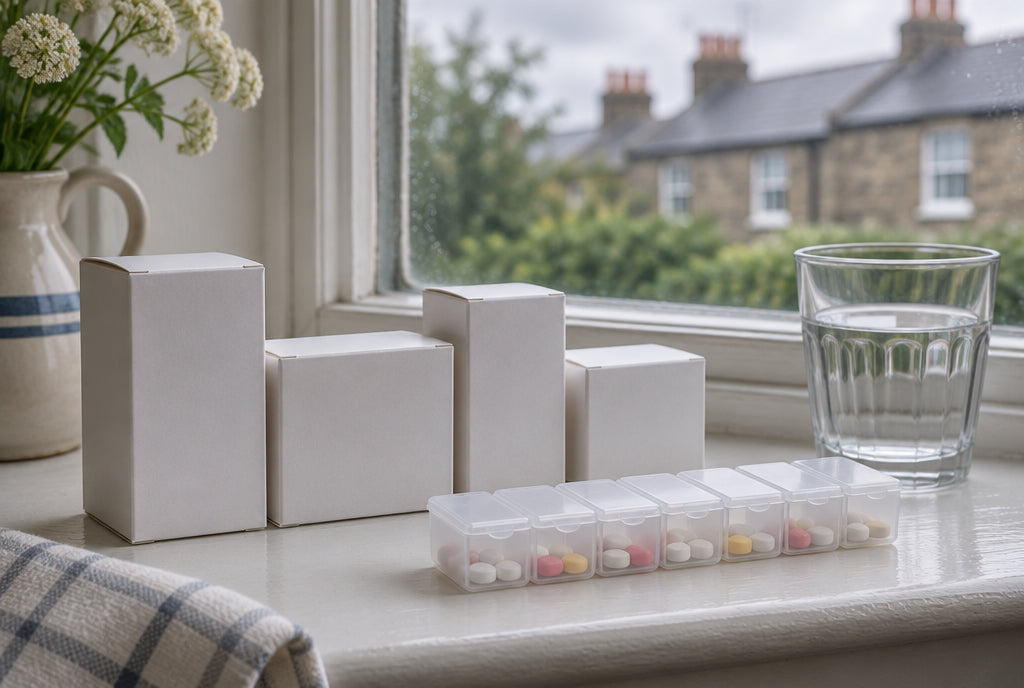
Selenium, zinc, Brazil nuts and "thyroid support" blends: some people do have deficiencies worth fixing. But these work on your diet and bloodstream, not the stressed tissue in your neck.
Gluten-free, dairy-free and elimination diets: they help some people with gut symptoms. But many women spend a year eating sweet potatoes and still hit the 2 p.m. wall.
Dose increases and switching medications: these fix the number. They're important, so keep working with your doctor on them. But they chase the gland. They don't support it.
Red light panels, masks and wands: people try them and see nothing, often because they're nothing like what the research did. More on that below.
Every one of these is aimed at the hormone, the diet or the skin. None of them is aimed at the gland.
The Research I Wish I'd Seen 10 Years Ago
 ✓ 830nm near-infrared · ✓ Contact design · ✓ 20-minute auto-off
If I'm honest, when I first heard "red light for your thyroid," I rolled my eyes. I've spent my career around people selling miracle kits.
Then I read the actual study. A randomized, placebo-controlled clinical trial from the University of São Paulo, published in 2013 in Lasers in Medical Science.1
- 43 patients with Hashimoto's, all on levothyroxine
- 830nm near-infrared, directly over the thyroid, against the skin
- A placebo group with an identical procedure
- Just 10 sessions: twice a week for five weeks
The study's own doctors then managed everyone's medication based on their blood results. At nine months:
I've read thousands of lab reports. That one made me put my coffee down.
And here's the part I'll never leave out: it was a small study using a clinical laser, not a home device. At the six-year follow-up,2 the light group still needed significantly less medication than placebo, but the gap had narrowed once the sessions stopped. Something real was happening at the gland, and it needs to be kept up, not done once.
Why I'm comfortable telling you about the Neck Wrap:
The problem at home was always delivery. Panels sit across the room, so the dose changes every time you move. Masks are mostly visible red. Wands cover a spot the size of a quarter. The Red Light Neck Wrap is the first home device I've seen built to do what the study did:
- It sits against the skin, so the dose is the same every session
- 830nm near-infrared (the study wavelength), plus 850, 630 and 660nm
- It wraps the whole gland, from collarbone to under the chin
- A 20-minute session, then it switches itself off
- Cordless: couch, kitchen table, bed
No pills. Nothing to swallow. Nothing to stand in front of. You put it on. You sit down. It does the work.
And here's what I appreciate most: they don't call it a cure.
Your thyroid condition is long-term. The Neck Wrap is a daily, then weekly, routine that supports the gland alongside your medication. That's how the research reads, and it's the honest way to say it.
See If the Neck Wrap Is Right For You →"Is It Safe on My Thyroid?"
It's the right question. Old panel manuals said to avoid the neck, and online advice ranges from "three minutes only" to "never." Here's what the evidence says:
Red and near-infrared light are non-ionizing. They're not UV and not X-ray, and they don't carry DNA-damaging energy.
In the six-year follow-up, the main safety outcome was thyroid nodules: 3 in the light group and 3 in placebo, all benign in the light group. The researchers concluded the treatment was safe as used.2
The real risk with home devices is guessing the dose. A contact wrap with a timed session removes the guessing.
Don't use it without medical advice if you have an overactive thyroid (including Graves'), thyroid cancer or an uninvestigated nodule, are pregnant, are photosensitive, or have an implanted electronic device in the neck or chest.
I'll Be Direct With You
In 23 years, I've watched women go through the same cycle:
Meanwhile their careers shrink, their afternoons disappear, and their families learn to plan around their naps.
I'm tired of watching it happen.
If you're reading this, you're still looking for an answer. You don't have to stop your medication, change your doctor or give up your bloodwork. You can add the one thing that's been missing: something aimed at the gland.
Your afternoons can't wait. Your family can't wait. And every year adds up.
If you recognize yourself in anything I've written today, please take the next step. Not someday. This week.

You Risk Absolutely Nothing. I Checked.
Give It 120 Days.
Or Get Your Money Back.
Long enough for the full 8-week routine, your routine bloodwork, and time to decide.
Before I'd put my name next to any product, I asked about the guarantee. 120 days. Not 30. Not 60. Changes at the gland take weeks, not days, and they'd rather you judge it properly.
If you don't feel a difference, email them and get a full refund.
Try the Neck Wrap Risk-Free for 120 Days →A Personal Note About the People Around You
Hashimoto's is never just one person's illness. It drains a whole household's energy, plans and patience.
I've read the posts from husbands who say, "I miss my wife. She's asleep by 8 and I don't know how to help."
I've read the posts from women who say, "My kids stopped asking me to play. They just assume I'm tired."
I've read the posts from daughters who watched their mothers fade on a "normal" result and are now terrified it's starting in them.
Here's what I want you to understand:
When a woman gets her afternoons back, the first thing she usually says isn't "I have more energy."
It's "My husband said I seemed like myself again." It's "I went to the whole soccer game." It's "My daughter asked why I wasn't napping."
If you won't do this for yourself, do it for them. They've been waiting too.
Start Your 8-Week Routine →How Does It Work? (It Takes 30 Seconds)
30 Seconds. That's All It Takes.
No setup. No appointment. No learning curve.
One thing women love is how simple it is. 20 minutes, 5 evenings a week, for 8 weeks. Then 1–2 sessions a week to maintain.
You don't change your medication. You don't change your doctor. You add twenty quiet minutes that, for once, are aimed at the gland.
Start Your 8-Week Routine Tonight →What to Expect in Your First 8 Weeks
A gentle warmth. Most notice nothing else, and that's normal.
Quiet first changes: an afternoon without the wall.
For some, a clearer head. Often family notices first.
Doctor check-in with bloodwork. Then maintenance.
Week 1: the warm-up. A gentle warmth on your neck. Most women notice nothing else, and that's completely normal.
Weeks 2–4: the first quiet signs. If changes come, they start small. Maybe an afternoon without the wall. Maybe not reaching for the cardigan.
Weeks 5–8: the people around you notice. For some women, a clearer head and steadier energy. Very often a partner or child says something before you do.
Week 8 and beyond: the check-in. Book your routine thyroid bloodwork and tell your doctor you're using it. Any medication change is your doctor's call. Then 1–2 sessions a week to maintain.
Everyone's thyroid is different, and nobody can honestly promise you a result. That's why the guarantee is 120 days.
See Today's Price →Questions People Ask Me Every Day
Do I keep taking my thyroid medication?
Yes. The Neck Wrap is used alongside your medication, never instead of it. Never change or stop your dose without your doctor.
Does it hurt? Will I feel anything?
A gentle warmth. No pulses, no sound. Near-infrared light is invisible, so you'll mostly just see the red.
My levels are "normal" but I feel awful. Is this for me?
That's exactly who I wrote this for. The test checks the hormone. The Neck Wrap is aimed at the gland.
I have high antibodies but I'm not on medication yet. Can I use it?
The research was done in people already on levothyroxine, so there's no direct study at your stage. Some women at that stage use it as part of looking after their thyroid. Talk to your doctor and keep your regular monitoring.
I've tried red light before and nothing happened. Why would this be different?
Ask which kind. The study used near-infrared against the skin, over the whole gland. Panels at a distance, red-only masks and wands for two minutes aren't the same thing.
Will I need it forever?
Honestly, plan on maintenance. The six-year follow-up showed the benefit narrowed once sessions stopped. After 8 weeks, most people drop to 1–2 sessions a week.
Why hasn't my doctor told me about this?
Not because they're hiding anything. There's no drug, no billing code and no standard guideline for "supporting the gland," so it simply isn't part of the routine. Take this page and the studies to your next appointment.
What if it doesn't work for me?
You have 120 days. If you don't feel a difference, get a full refund.
- Höfling DB, et al. Low-level laser in the treatment of patients with hypothyroidism induced by chronic autoimmune thyroiditis: a randomized, placebo-controlled clinical trial. Lasers Med Sci, 2013. doi:10.1007/s10103-012-1129-9
- Höfling DB, et al. Safety and efficacy of low-level laser therapy in autoimmune thyroiditis: long-term follow-up study. Int J Endocrinol, 2018. doi:10.1155/2018/8387530
- American Thyroid Association. Hashimoto's Thyroiditis. thyroid.org
*These statements have not been evaluated by the Food and Drug Administration. The Red Light Neck Wrap is a wellness device. It is not intended to diagnose, treat, cure or prevent any disease and is not a substitute for prescribed medication or medical advice. The studies referenced used a clinical 830nm laser, not the Neck Wrap. Never start, stop or change any medication without your doctor. If you are falling asleep while driving, stop driving and see a doctor promptly. Individual experiences vary. This page is a paid advertisement by the Neck Wrap.